119 - The Poverty Tax 🏁🇺🇸
THE JOURNEY TO 124
Post 119 of 124 • 95.97% Complete
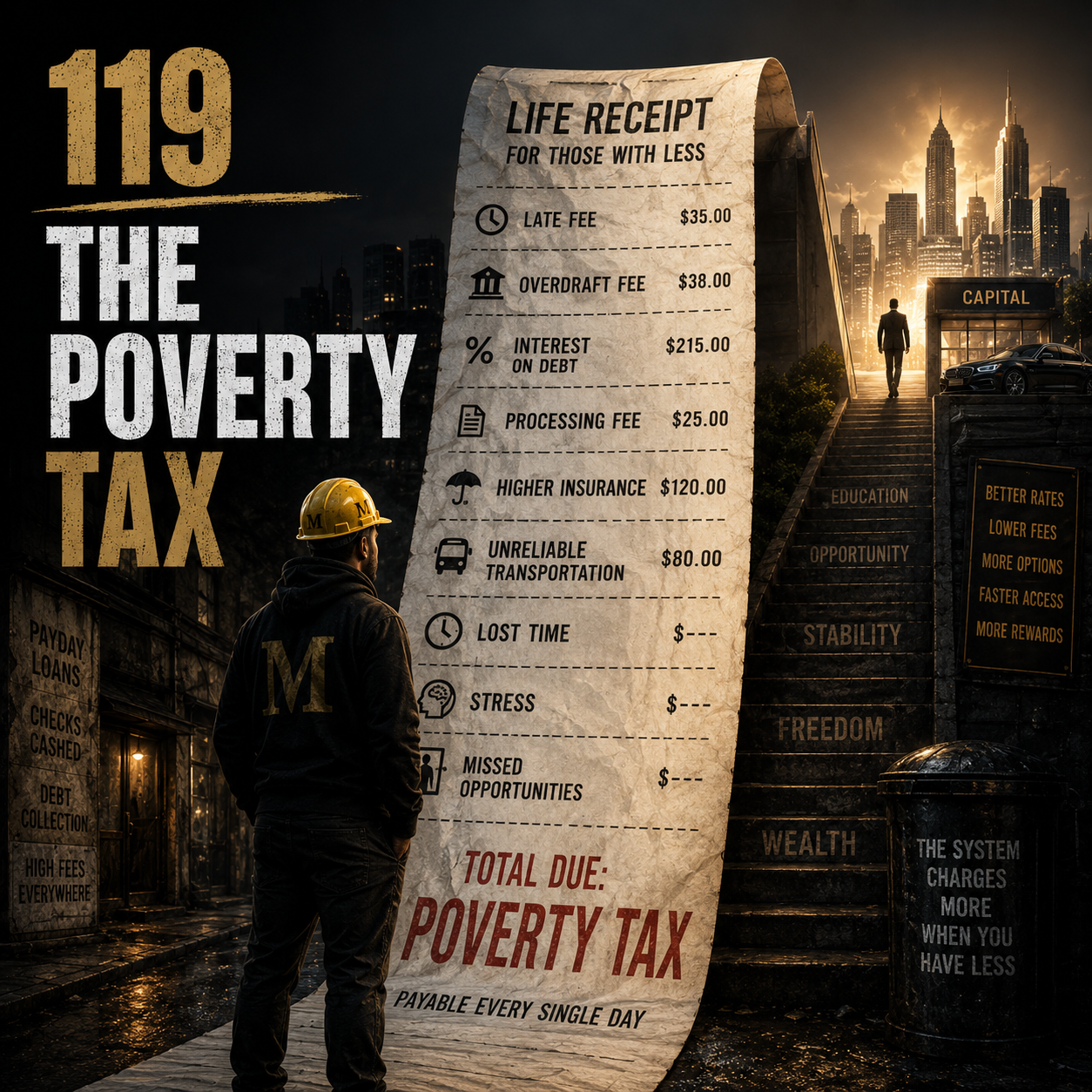
“The Poverty Tax” (GPT5.5 Render Version b)
Every time I hear someone say, “Money isn’t everything,” I wonder whether they have ever truly been broke.
Money may not be everything, but the absence of it has a way of reaching into everything. It affects where you live, how you travel, what emergencies you can survive, how much time you spend solving problems, and how many choices remain available when something goes wrong. There is a strange contradiction built into modern life. When you have money, the world competes for your business. Banks offer better rates. Credit cards offer rewards. Companies waive fees, extend privileges, and provide easier access to capital. Success seems to attract better terms.
When you do not have money, the opposite often happens. Interest rates rise. Late fees accumulate. Overdraft charges appear. Deposits become harder to afford, transportation becomes less reliable, and one unexpected expense can disrupt an entire month. The poorer you become, the more expensive life gets.
That is the poverty tax.
It is not an official tax written into law. It is the collection of penalties, premiums, lost time, reduced choices, and added stress that often accompany financial hardship. It is paying more because you cannot afford to pay everything at once. It is accepting worse terms because better terms are reserved for people who need them less. People with resources can buy quality once. People without them may have to replace cheaper items repeatedly. Those with savings can absorb an emergency. Those without savings may have to borrow money to survive it, turning one difficult moment into months or years of repayment.
Even time becomes more expensive when money is scarce.
A person with resources can pay for convenience, reliable transportation, faster service, professional assistance, and preventive maintenance. A person without those resources may spend hours waiting, comparing, repairing, negotiating, commuting, or trying to avoid another fee. The poverty tax is paid in dollars, but also in time, energy, sleep, and peace of mind. I have experienced seasons when opportunity seemed abundant and seasons when every dollar carried the weight of three. I have invested in education, equipment, licensing, businesses, music, research, and ideas because I believed they could eventually create something meaningful. Sometimes building a future requires spending money before that future begins paying you back.
That is one of the hardest parts of trying to move forward. Progress often has an admission price. There are tools to purchase, credentials to earn, skills to develop, and hours of work that may not produce an immediate return. The people who most need an opportunity are often the same people least able to absorb the cost of pursuing it. Still, when income finally arrived during one especially demanding season, the first thing I did was not pay myself.
I tithed.
I did not tithe because the numbers were comfortable. I tithed because I had decided that God would receive the first portion, not whatever happened to remain after every bill and obligation had taken its share. Faith is easy to describe during abundance. It becomes more revealing during scarcity. Afterward, I looked at what remained and thought about how many people quietly perform that calculation every day. Rent or medicine. Food or transportation. A utility bill or a necessary repair. They are not careless people. They are people trying to stretch limited resources across obligations that refuse to become smaller simply because their income did.
Financial hardship is often discussed as though it were only a failure of discipline. Discipline matters, but discipline alone cannot erase structural disadvantages, unexpected emergencies, low wages, rising costs, or years of accumulated penalties. Sometimes the problem is not that someone refuses to work. Sometimes the problem is that the work does not leave enough behind. I have always respected craftsmanship, service, and contribution. I respect the engineer who builds something that works, the musician who practices when nobody is listening, the nurse who quietly saves lives, the mechanic who refuses to cut corners, and the teacher who changes the direction of one student’s future. Those people create value first.
Recognition may come later, or it may never come at all.
When I look back at my own life, I see more than one hundred DJ mixes, more than one hundred music releases, engineering, artificial intelligence, research, companies, and ideas that may never make me wealthy but still deserve to exist. Some people measure success only by what they can extract. I have always wanted to measure it by what I can contribute. I am not against money. Money can create stability, reward effort, provide freedom, support families, fund innovation, and allow people to help others. It is one of the most powerful tools available to us. But money should support life. Life should not be reduced to a permanent struggle to satisfy money. The poverty tax is real. It grows through fees, interest, limited options, lost time, and the quiet exhaustion of always having to calculate what can wait.
Yet hardship does not have to determine character.
When the numbers do not work, when the hours feel endless, and when every choice carries consequences, we still have to decide who we are going to be.
The poverty tax may take money.
I pray it never takes my integrity.
🏁
Share this post and help others recognize the hidden costs of financial hardship while protecting their integrity through difficult seasons.


Manish Miglani | Mani
============ ====
Techno Artist. AI Innovator. Building Sustainable Futures in Music, Space, Health, and Technology.
CEO & Co-Founder: MaNiverse Inc. & Nirmal Usha Foundation
Website: http://www.manimidi.com
My YouTube Channel: http://youtube.com/@djmanimidi
Book an Appointment: https://calendly.com/manish-miglani/30min
UIC Work: Master's in Engineering with an AI/ ML Focus (Graduated Aug 2025)
============================================================
QoTD: “Treat the garbage man with the same respect as given to the CEO." - Manish Miglani, Clean It Up LLC
Must Read: https://futurism.com/space/statistic-kessler-syndrome-crash-clock