067 - The Architecture of Leadership

Manish Miglani, on a Systems Call
Leadership is often misunderstood because people reduce it to personality, visibility, or charisma. In reality, leadership behaves more like architecture. It is something that must be designed, constrained, and tested before it is ever relied upon. When it is built incorrectly, it does not fail immediately. It fails under pressure, and when it does, the cost is carried by everyone else.
The core mistake is believing leadership begins with the individual. It does not. It begins with the system that surrounds the individual. If outcomes depend on a person, the system has already failed. Strong leadership is not about being at the center. It is about ensuring the system holds, regardless of who is inside it.
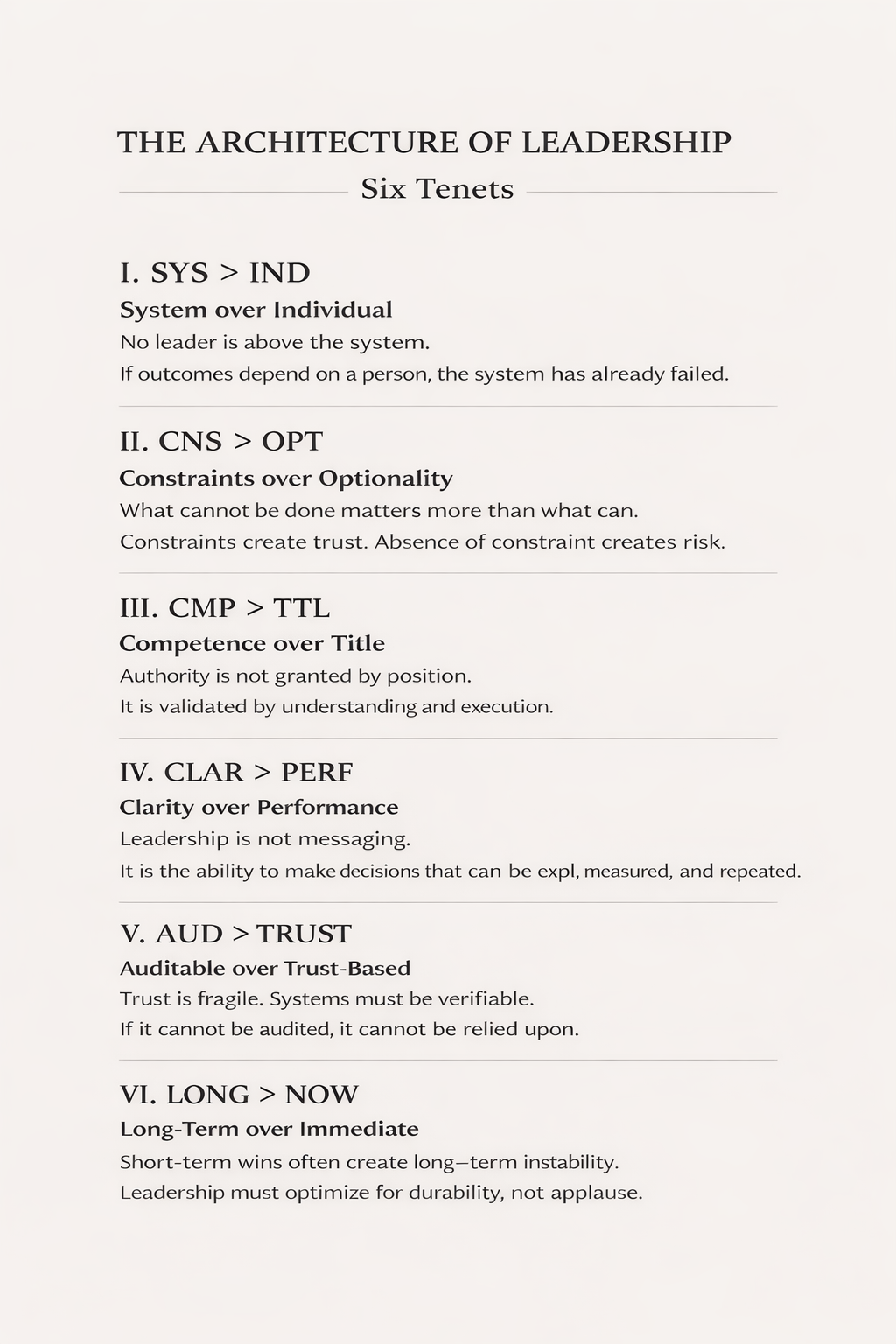
6 Tenets (GPT5 Render)
Constraints are what make leadership credible. Without them, decisions become arbitrary, and power becomes personal. With them, decisions become explainable, and authority becomes accountable. What cannot be done matters more than what can. Without clearly defined limits, there is no structure, only improvisation.
Competence must come before authority. Not in the sense of knowing everything, but in understanding systems well enough to recognize failure before it scales. Titles do not protect against consequences. Systems do. Leadership is ultimately the responsibility of outcomes, and outcomes do not respond to status.
Clarity must come before performance. Modern leadership has drifted toward messaging, optics, and visibility. But systems do not respond to performance. They respond to clear inputs, defined processes, and measurable outputs. If a decision cannot be explained, it cannot be trusted. If it cannot be repeated, it cannot be scaled.
Trust alone is not enough. Systems must be auditable. Leadership that depends entirely on belief will eventually break under pressure. Verification is not a lack of trust. It is the foundation of durability. What can be examined can be improved. What cannot be examined eventually fails.
And none of this matters if leadership is optimized for the immediate. Short-term wins often create long-term instability. Real leadership must operate on a longer horizon, where decisions are judged not by immediate reaction, but by sustained impact over time.
These are not abstract ideas. They are already in motion. Artificial intelligence, data-driven governance, and global interdependence are already reshaping how decisions are made and how quickly they scale. Leadership that is not designed for this level of complexity will not survive it.
In that context, stronger alignment between India, the United States, and Nepal is not optional. It is necessary. The cultural, economic, and strategic intersections between these regions are becoming more important, not less. Technology, security, and development will increasingly depend on cooperation across these systems. That reality is clear to those paying attention, and it requires leadership that understands both systems and people.
For me, this is not about stepping into leadership. It is about building toward it in a way that is structured, disciplined, and real. Because if the architecture is wrong, nothing built on top of it will last. And if it is right, leadership becomes less about the individual and more about what continues to function long after they are gone.
These are not ideals.
They are constraints.
Share this post — because leadership should be built, not performed.


Manish Miglani | Mani
============ ====
Techno Artist. AI Innovator. Building Sustainable Futures in Music, Space, Health, and Technology.
CEO & Co-Founder: MaNiverse Inc. & Nirmal Usha Foundation
Website: http://www.manimidi.com
My YouTube Channel: http://youtube.com/@djmanimidi
Book an Appointment: https://calendly.com/manish-miglani/30min
UIC Work: Master's in Engineering with an AI/ ML Focus (Graduated Aug 2025)
============================================================
QoTD: “Treat the garbage man with the same respect as given to the CEO." - Manish Miglani, Clean It Up LLC
Must Read: https://futurism.com/space/statistic-kessler-syndrome-crash-clock